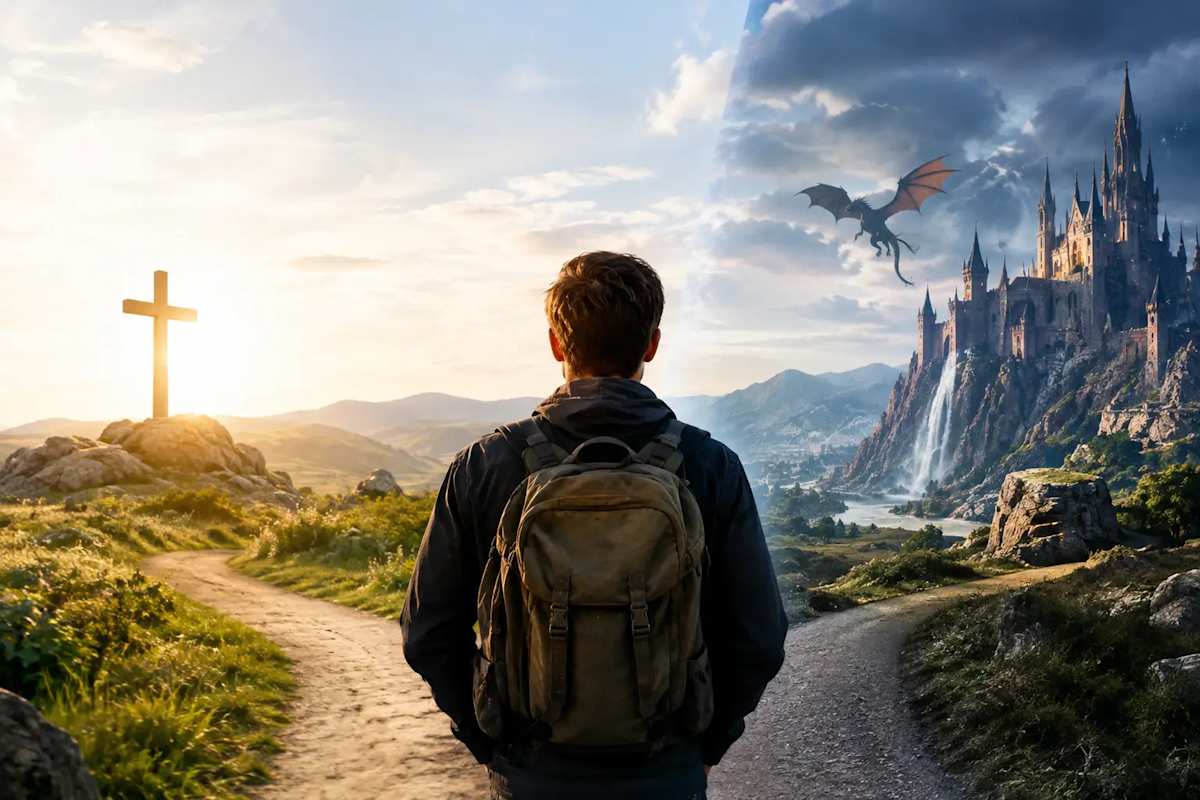
A boy stands at the edge of a mountain trail, carrying questions about his missing father. Strange things are happening in the woods. A loyal friend is beside him. He is afraid, but he prays and keeps walking. That picture gets close to the heart of faith based adventure vs fantasy. Both can carry readers into mysterious places. The difference often lies in what the mystery asks of the human heart.
For families, grandparents, young readers, and adults who still love a good story of courage, this is not a small question. Many readers enjoy imaginative worlds but want a story that does not leave them in darkness, cynicism, or confusion. They want danger that has meaning, wonder that points somewhere, and characters whose choices matter.
Faith Based Adventure vs Fantasy: The Real Difference
Fantasy is a broad storytelling tradition. It may include imagined kingdoms, mythical creatures, unusual powers, enchanted objects, parallel worlds, or events that reach beyond ordinary explanation. Some fantasy is gentle and hopeful. Some is frightening, morally tangled, or built around a worldview far removed from Christian faith. The label alone cannot tell a reader what rests at the center of the story.
Faith-based adventure is defined less by the presence or absence of extraordinary events and more by its spiritual foundation. It can take place in a real forest, an old mountain town, a distant sea, or a world touched by the unexplained. What makes it faith-based is the way the story understands truth, evil, love, sacrifice, forgiveness, and hope.
In a faith-informed adventure, prayer is not a lucky charm pulled out when the plot needs help. Faith is part of a character's life. It may be tested by grief. It may feel difficult when God seems quiet. Yet the story recognizes that people are not alone in their suffering and that courage can grow from trusting something greater than themselves.
That does not mean every faith-based adventure must explain every mystery. A mountain can remain mysterious. A strange light can still stir the imagination. A reader can wonder what waits around the next bend. But the story's moral compass remains steady, even when the path is not.
Imagination Does Not Have to Compete With Faith
Sometimes readers assume they must choose between a spiritual story and an imaginative one. They may worry that fantasy will make faith feel thin, or that faith-based fiction cannot be surprising, eerie, or full of discovery. Neither assumption is necessary.
The natural world already carries more mystery than we can fully explain. Mountains can feel ancient and watchful. A fog-covered trail can make a familiar place seem changed. A child facing loss can experience ordinary events with an intensity that feels almost otherworldly. Adventure fiction can honor that sense of wonder without making darkness the final word.
Fantasy can also use invented elements to explore real questions. What is courage when no grown-up can solve the problem? What does friendship look like when fear makes running away easier? Can a young person carry grief without being defined by it? Those questions belong just as naturally in a mountain mystery as they do in a faraway kingdom.
The key is discernment. A story with unusual phenomena is not automatically harmful, and a story set in an ordinary town is not automatically spiritually nourishing. Parents and readers may want to look beyond the category on the cover. Ask what the story celebrates. Notice whether it treats moral choices as meaningful. Pay attention to whether hope is earned through love, truth, and sacrifice, or whether the book insists nothing matters except power.
When Faith Gives Adventure Its Stakes
Adventure needs danger, but danger by itself can become empty noise. A chase, a storm, a hidden cave, or an unexplainable presence becomes memorable when someone has something precious to lose. In faith-based adventure, that precious thing is often deeper than survival.
A character may be fighting to hold onto trust after a parent disappears. He may need to tell the truth when a lie would protect him. She may discover that loving a friend means staying near when it would be safer to leave. These are spiritual stakes because they reveal who a person is becoming.
Faith also gives room for honest fear. Christian stories do not need to pretend that faithful people are never frightened. David faced giants. The disciples faced storms. Many of us have stood in our own quiet storms, wondering what tomorrow will bring. A young protagonist who trembles, prays, makes mistakes, and keeps going can offer readers something far more lasting than a hero who never needs help.
This kind of storytelling is especially meaningful for middle-grade and young adult readers. Those years are filled with transitions that can feel like an unfamiliar wilderness. Children begin to see that adults cannot fix every hurt. They begin asking who they are, where they belong, and whether their choices matter. A sincere adventure gives them a place to feel those questions safely.
It can also speak to adults. A parent may recognize the ache of family separation. A grandparent may remember the first time a story made the world feel larger and more alive. A reader carrying old grief may find comfort in watching a character move through sorrow without surrendering to it.
What Families Can Look for in an Adventure Story
There is no single answer for every household. One family may welcome a suspenseful mystery that another child finds too intense. Age, sensitivity, maturity, and personal experience all matter. Still, a few questions can help readers decide whether a book is likely to be a good companion for the journey.
Consider whether the story treats evil as something to resist rather than admire. Notice whether frightening scenes serve a meaningful purpose or simply pile on shock. Look for relationships marked by loyalty, honesty, and growth. And ask whether faith is treated with respect, even when characters wrestle with doubt.
It also helps to consider the emotional landing place. A wholesome story does not have to avoid sadness. Some of the most soul-moving stories make room for tears. But readers deserve a sense that sorrow is seen, love is real, and hope has not been forgotten.
A good family adventure often creates conversation after the final chapter. A child may ask why a character forgave someone. A parent may ask what bravery looked like in a difficult scene. Those conversations are part of the gift. Stories can open a door that everyday life sometimes leaves closed.
A Mountain Mystery Can Hold Both Wonder and Prayer
In Bowl Top Mountain, the adventure begins with a boy named David searching for answers about his missing father. The mountain holds danger, friendship, strange occurrences, and the kind of questions that do not disappear just because someone is young. Yet the story is not interested in using mystery merely to unsettle the reader.
Its heart is found in David's journey toward courage, belonging, faith, and love. Christy, friendship, family pain, and the unseen weight of prayer all matter alongside the discoveries made on the mountain. The unexplained elements are there to deepen the journey, not replace the human and spiritual truth at its center.
That balance is what many readers are seeking when they ask for faith-informed adventure. They want the page-turning pull of a mystery, but they also want to close the book with something more than a thrill. They want to carry away a reminder that even a frightened heart can take the next step.
Let the Story Lead Toward Hope
The best choice between faith-based adventure and fantasy is not always a choice between two opposing shelves. A story may contain mystery, imagination, and even things that cannot be easily explained while remaining deeply rooted in Christian hope. What matters is the spirit of the journey and the truth it leaves with the reader.
Choose stories that make room for wonder without asking the soul to abandon its bearings. Choose adventures where courage costs something, friendship endures, and love has the strength to lead someone home. A good story may take us into the shadows for a while, but it should give us a reason to keep looking for the light.